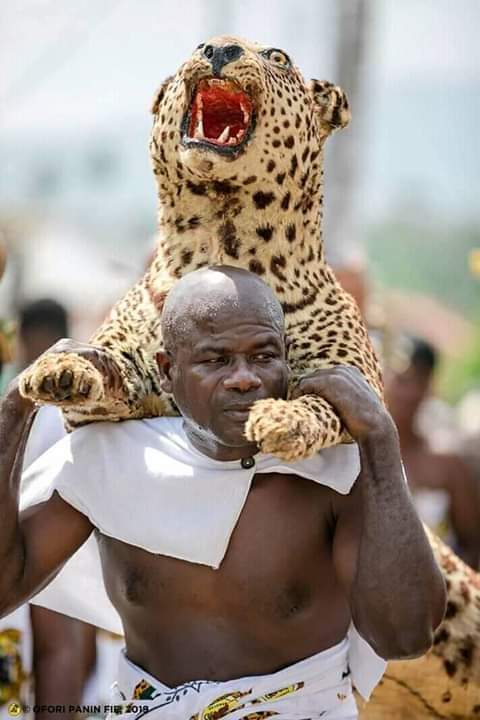
Ohum festival of Okyeman was brought by Tafohene Nana Okru Banin over 200 years ago and since then the occupant of Aduana Abrade stool of Akyem Tafo is the custodian of the Ohum festival.
Ohum is celebrated in June, July or in August annually and the purpose of celebrating Ohum is to usher in a new yam (Kokooase Bayerɛ) and give thanks to God the Almighty, the Ancestors and gods of the land for protection and provision of abundance of new yam.
The festival could also be called Yam Festival because it is celebration of a new yam.
The date for celebration of Ohum festival is strictly reserved for Nana Tafohene.
Before the date comes out for the celebration of Ohum festival, Nana Tafohene with his elders will go to the sacred forest in Tafo to offer a sacrifice , afterwards they go to a sacred Palm Tree to pluck the fresh palm fronds, (Mɛnkɛnsono) and if it is plucked it means permission is granted for the celebration of Ohum, if it is not plucked it means no permission is granted therefore Ohum cannot be celebrated.
If permission is granted for the celebration of Ohum by the gods, Nana Tafohene will go to Ofori Panin Fie in Kyebi and inform his Overlord, the Ɔkyenhene, the date for the celebration.
Upon receiving the date for the celebration, Ɔsagyefoɔ Ɔkyenhene will make declaration of two weeks ban on noise making, libation is poured and Atumpan is sounded to seal the declaration.
All these while new yam is not permitted to be eaten until final ritual is performed to usher in the new yam.
In the week for the celebration of the festival in Kyebi, on Tuesday, the final ritual is done to grant permission to eat new yam. Mashed yam (Ɛtɔ) is prepared for the ancestors in the stool room, sheeps are slaughtered and schnapps are and other wines offered to them.
At Atoase, children with palm fronds, bare-footed with clothes on their waist will go round the sacred altar and chant Ohum o! Ohum o! Ohum o!
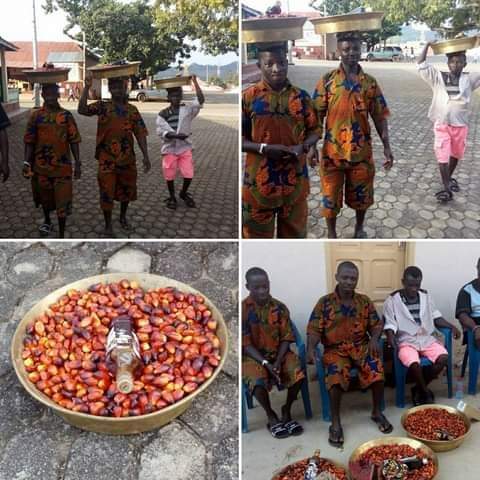
In the evening, Nana Bansohene, the custodian of Ɔkyenhene’s Banmu in Banso, will come to Ofori Panin Fie by walking all the way from Banso in Atiwa West district to Kyebi in the East Akyem Municipality to offer his gift of fresh palm fruits full of three brass pans; one for Ɔsagyefoɔ Ɔkyenhene, one for Ɔwoo-Abrɛmpɔn Abrewa Dokua, and the last one is for Ɔsabarima Abɔntendɔmhene.
Nana Abɔntendɔmhene will receive Nana Bansohene or either his delegation and give them a place to sleep and eat and in the following morning he leads them to Ofori Panin Fie to present the items to the King,
the King will then accept the gifts as the custom demands and in return give them one fat sheep to Banso to carry out a sacrifice in Banmu for the ancestors. They are to return to Banso by foot again o.
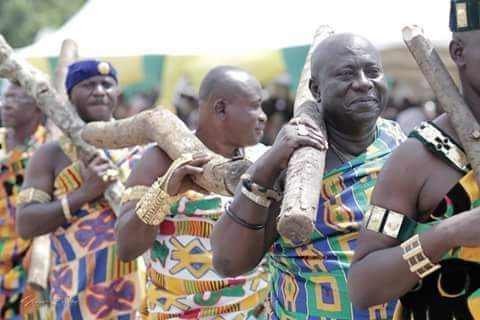
Since the festival is mostly celebrated in the wet season and during this period the temperature becomes so cold, it is a custom that the natives visit various palaces with a piece of firewood each for the chiefs in the various palaces to warm themselves.
His Majesty, Ɔsagyefoɔ Ɔkyenhene receives his presentation of pieces of firewood from his sub-chiefs.
On grand durbar day, His Majesty sits in state to receive greetings from his sub-chiefs, invited chiefs, the Executive arm of Government of Ghana, the Legislature, Judiciary, Members of Diplomatic Corp and all other high profiled dignitaries.
In the evening of the durbar day, the youth are also not left out, they equally get their fun percentage of the festival.
A full packed street carnival is organized for the youth where the Gospel and Dance Hall Artistes are invited to perform live.
Source:Gnews.com
 G-News